.png)
What Does a Professional Pool Inspection Cover? An Austin Expert's Breakdown
inspector doing a pool inspection
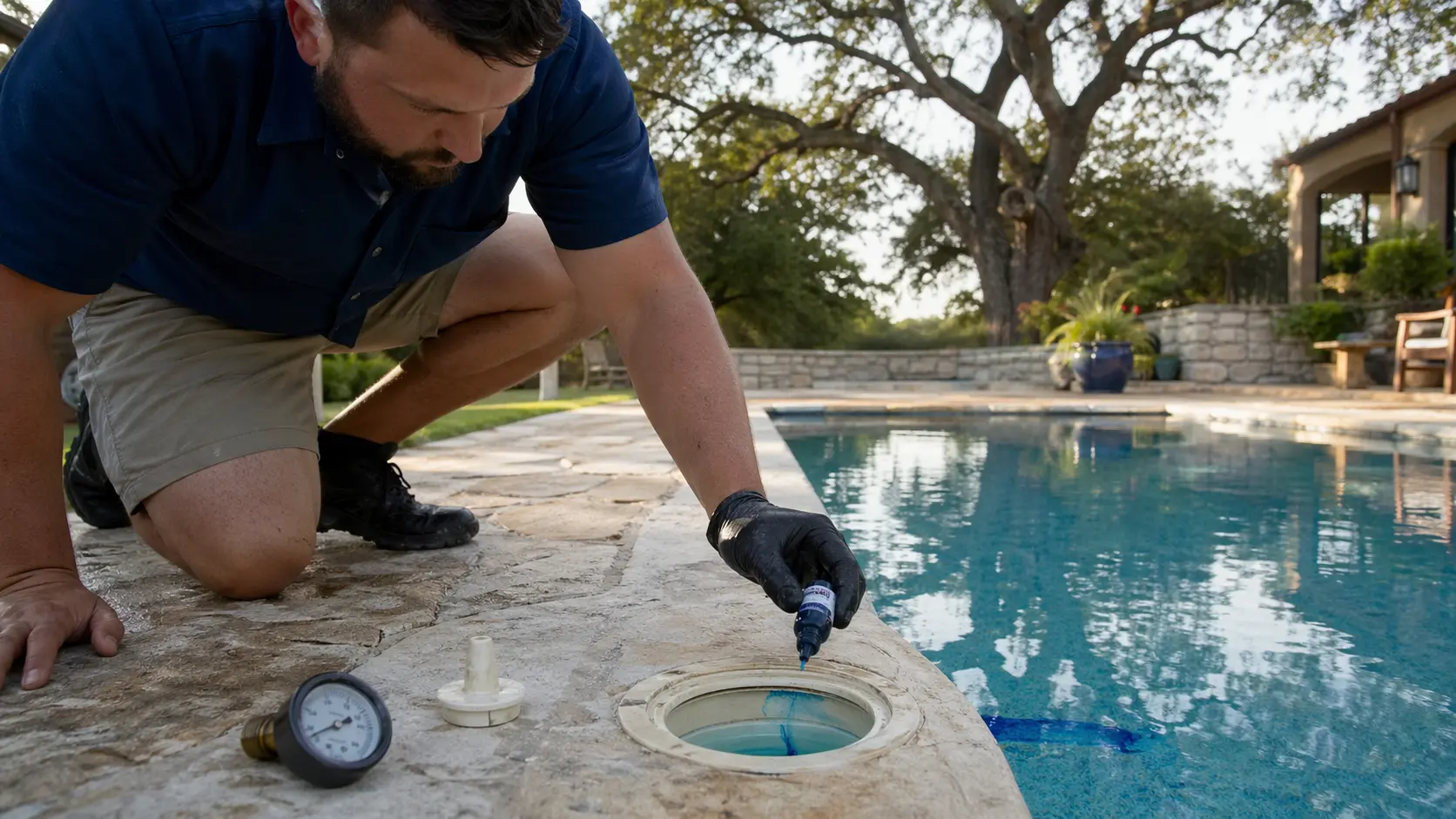
You're about to close on a home in Lakeway. The backyard has a gorgeous pool. The home inspector spent maybe 10 minutes near it. He noted the pump ran, the water looked clean, and the light turned on. The report says "pool in good condition."
Six months later, the auto-fill is on almost every day. Your first summer water bill is double your neighbor's. Something under the deck has been slowly leaking since before you moved in.
This is one of the most common scenarios we see on resale pools across the Austin area. So what does a professional pool inspection cover, and why is it so different from the pool check baked into a standard home inspection? Here is the full breakdown, plus the Hill Country red flags most inspectors never look for.
Why Most "Pool Inspections" in Austin Miss the Expensive Stuff
Most general home inspectors are not pool inspectors. They don't carry specialty tools. They don't pressure test plumbing. They don't run dye tests on skimmers or scope suction lines. They check that the pump turns on, the water looks blue, and nothing is obviously broken.
That is fine for a glance. It is not an inspection.
A real pool inspection covers six different systems, and every one of them can fail on its own. On Austin pools, at least three of those systems take a beating from local conditions a general inspector never factors in.
Nine times out of ten, when we get called out after a real estate deal goes sideways, the "pool check" was a visual walkthrough. Nothing was pressure tested. Nothing was scoped. The buyer inherited a problem the inspection should have flagged before closing.
If you are buying a home with a pool in Austin, Cedar Park, Round Rock, Lakeway, or anywhere in the Hill Country, the inspection you need is not the one inside your home inspector's report. Call a pool specialist. Book a pool inspection here.
What Does a Professional Pool Inspection Cover? The 6 Systems
A real pool inspection covers six distinct systems. Skip one, and you are gambling. Here is what we check on every job.
1. Structure and surfaces
- Plaster condition, hollow spots, staining, etching
- Tile line for cracks, missing grout, or freeze damage
- Coping separation from the bond beam
- Deck gaps, settling, and sealant condition
- Any visible cracks in the shell
2. Plumbing and circulation
- Skimmer throats and weirs
- Return jets, flow direction, and pressure
- Suction lines, main drain, and air leaks
- Valve operation and condition
- Any wet spots or signs of slow leaks at fittings
3. Equipment pad
- Pump: bearings, seals, motor, priming behavior
- Filter: pressure reading and internal condition
- Heater: ignition, scale buildup, vent integrity
- Automation: controls, timers, and sensors
- Visual check of pad wiring and bonding
4. Safety and function
- Drain covers (VGB compliance, cracks, age)
- Ladders and rails: mounting and corrosion
- Light operation and visible wiring
- Fence and gate latches, where applicable
- Alarms and safety covers, if present
5. Water-loss screening
- Waterline review and fill-line checks
- Bucket test to separate evaporation from a leak
- Dye tests on suspect fittings and skimmers
- Visual plumbing check for soft spots in the yard
- Pressure anomalies at the equipment pad
6. Photo-documented report
- Every finding photographed on site
- Plain-English explanation of each issue
- Priorities sorted: fix now, fix soon, monitor
- Cost-range guidance on the bigger items
- A clear next step if full pool leak detection is needed
That last part matters. A good inspection gives you action, not anxiety. You should walk away knowing exactly what is urgent and what can wait.
The Austin Red Flags a Real Pool Inspection Catches
A pool in San Diego does not age the same way a pool in Buda ages. Central Texas conditions create specific failure patterns, and a good Austin pool inspector looks for them on every call.
Central Texas freezes hard every few years. The 2021 event cracked tile, plumbing, and equipment across Austin. More recent freezes have done the same at a smaller scale. Hairline cracks in tile and skimmer throats can hide for a full season before they start leaking in volume. Any pool that has been through a hard freeze deserves a thorough freeze-damage check.
Expansive clay and limestone shift
Large parts of the Austin area sit on expansive clay. When it swells and contracts with wet and dry cycles, pool decks move. Coping separates. Bond beams hairline crack. Equipment pads tilt just enough to stress plumbing. A pool inspection in our area should flag every early sign.
Hard water and heater scale
Austin's municipal water is hard. Over a few seasons, calcium scale builds up inside heater heat exchangers. A heater that "runs" on inspection day can still be on its way to an expensive failure. A real inspector listens for the signs and checks the flow pattern.
Summer sun and UV wear
Texas summers cook sealants and deck coatings. Caulk joints that look fine in spring are often split wide open by August. An inspection in May can catch what July will expose.
Every one of these is something we specifically check on inspections across Austin, Lakeway, West Lake Hills, Leander, Cedar Park, Round Rock, Pflugerville, Buda, San Marcos, New Braunfels, and Canyon Lake.
Pool Inspection vs. Home Inspection: What Actually Gets Covered
This is the chart we wish every home buyer saw before closing.
A home inspector's pool section is a courtesy check. A professional pool inspection is a diagnostic.
Red Flags That Mean You Need a Pool Inspection Now
Call a pool inspector in the Austin area if you are seeing any of these signs:
- The auto-fill runs more than it used to
- You are topping off more than a quarter inch per week beyond normal evaporation
- Your water bill jumped with no change in household use
- New cracks showed up in the plaster, tile, or coping
- The equipment pad is making new noises
- The pool is part of a resale deal and no pool specialist has looked at it
- You lived through a hard freeze and have not had the pool checked since
Two or three of those at once is your answer. Small issues on Austin pools turn into structural problems fast once the summer heat hits. Schedule a pool inspection before the problem doubles in size.
If you already know you are losing water, skip straight to pool leak detection. We use sonar, pipe cameras, and pressure testing to find the exact spot without digging.
What a Professional Pool Inspection Costs in Austin
Pricing in the Austin area generally runs in line with a standard home inspection, depending on pool size, equipment complexity, and whether full leak screening is included. Spas add time. Large pools with complex automation add time. A simple gunite pool is quicker.
What you should get for the money, every time:
- 60 to 90 minutes on site (longer for larger pools or spas)
- Visual inspection of all six systems listed above
- Non-destructive water-loss screening
- A photo-documented report within 24 hours
- Clear next steps, sorted by priority
If we find a likely leak during screening, we can upgrade on the spot to a full leak detection. No second trip, no second invoice for the drive out.
When to Schedule a Pool Inspection
There are four moments when a pool inspection in Austin is worth every dollar:
- Before buying a home with a pool. This is the single highest-ROI time to call. A good inspection before closing protects your negotiation leverage and your wallet.
- After a hard freeze. Even if the pool looks fine, the tile, plumbing, and equipment often are not.
- Before opening the pool for summer. Catch small issues before the Texas sun and heavy use expose them.
- When you suspect water loss. Evaporation versus a leak is an easy call for a trained eye and a bucket test.
Related reading: if you are in a real estate deal right now, see our guide on what to check before buying a home with a pool in Austin.
Book Your Austin Pool Inspection
A professional pool inspection covers six full systems, the Hill Country red flags most inspectors miss, and ends with a photo-documented report you can actually use. We come out, run every check, and leave you with a prioritized plan.
If you are buying a home, selling a home, or just worried about water loss anywhere in Austin, Buda, Lakeway, San Marcos, Canyon Lake, New Braunfels, Cedar Park, Round Rock, Pflugerville, Leander, or West Lake Hills, book an inspection with Austin Pool Leak Detection.
Call 737-394-5325 or request a quote online. Same-day scheduling is available across our service area.
.png)