.png)
How Locating Pool Leaks Can Save You Money
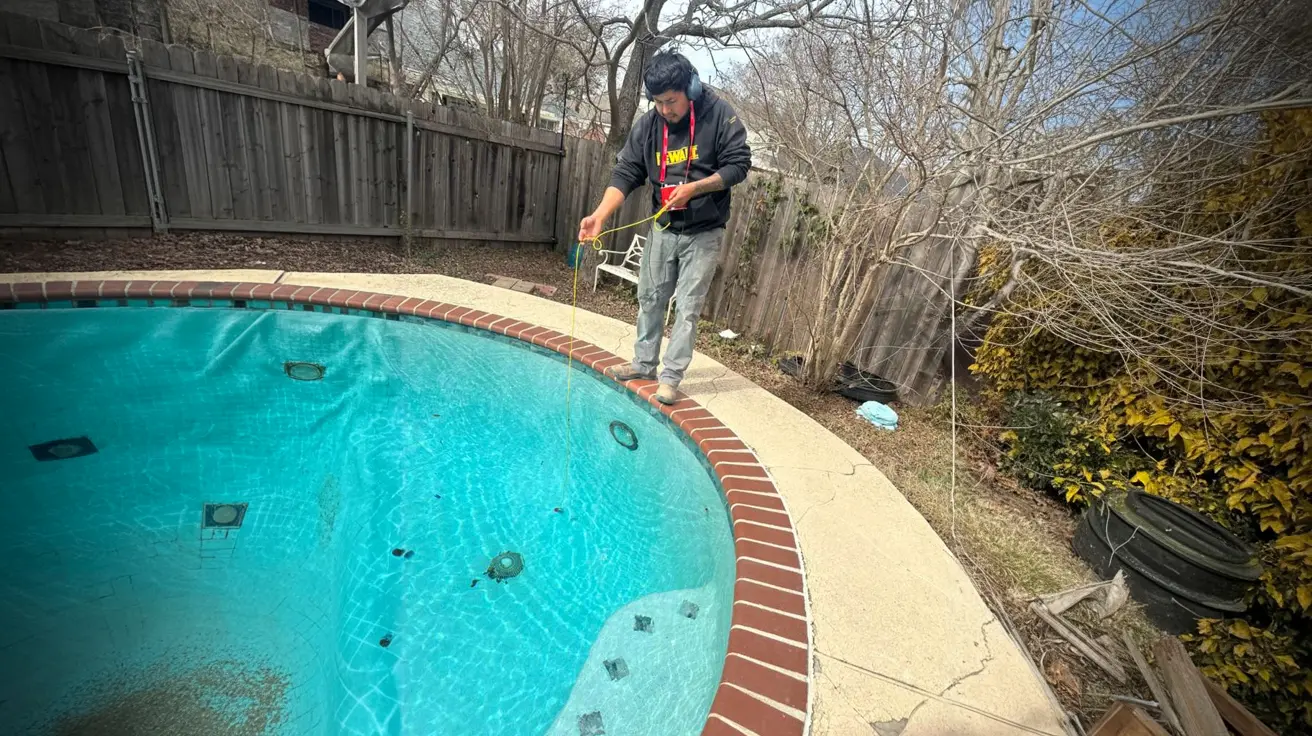
Learn how to detect a leak using the bucket test, dye test, and professional pool leak detection. Call 737-394-5325.
How Locating Pool Leaks Can Save You Money
If you own a swimming pool in Austin, TX, there is a good chance you have watched the water level drop and wondered whether you have a leak somewhere or just normal evaporation. It is a fair question. Every pool loses water to evaporation, especially during Austin's brutal summers. But when the water level drop goes beyond what the sun and wind can explain, something more expensive is happening beneath the surface.
A pool leak, even a small one, can waste thousands of gallons of water per week, drive up your utility bills, damage the soil around your property, and shorten the life of your pool equipment. The longer it runs, the worse it gets. That is why locating pool leaks early is one of the smartest financial decisions any pool owner can make.
At Austin Pool Leak Detection, we help homeowners across Austin, Lakeway, Buda, San Marcos, New Braunfels, and Canyon Lake locate leaks with precision using advanced leak detection equipment. In this guide, we will walk you through how to spot the signs of a pool leak, how to test for one at home, and how professional pool leak detection can save you real money before a minor issue turns into a major repair.
Signs of a Pool Leak vs. Normal Evaporation
Before you start worrying, it helps to understand what is normal and what could indicate a leak. Austin pools typically lose about a quarter inch of water per day to evaporation during the summer. Factors like wind, humidity, sun exposure, and whether you use a pool cover all affect how much water disappears naturally. That kind of loss is expected and nothing to stress about.
But when the water level in your pool drops faster than that — say half an inch or more per day — you may have a leak somewhere in the system. Here are the most common signs of a pool leak that Austin homeowners should watch for:
- The water level drops noticeably between fills. If you notice the water level falling an inch of water or more every few days, and you are constantly running the autofill or garden hose, that rate of loss is almost certainly not evaporation alone.
- Your water bills keep climbing. A swimming pool leak losing just one inch of water daily can waste 7,000+ gallons per month. That shows up fast on a utility bill, especially with Austin's tiered water rates.
- Wet areas around the pool or yard. If you see soggy patches, soft ground, or standing water in areas around the pool that do not receive irrigation, water may be escaping from underground plumbing and saturating the surrounding soil.
- The pool pump loses prime or gulps air. When the water level drop reaches the bottom of the skimmer, the pump starts sucking air. You may hear gurgling near the skimmer or notice air bubbles in the pump basket. This is hard on the motor and a clear sign something is off.
- Chemical demand increases for no clear reason. A leak constantly introduces fresh, untreated water into the pool. You end up adding more chlorine, more acid, and more stabilizer just to keep up — all of which costs money.
- Cracks in the pool deck or shifting soil. Water escaping underground erodes the base material beneath the deck, causing settling, cracking, and separation. If your pool deck is developing new cracks, a leak beneath it could be the cause.
Any one of these signs is worth investigating. When two or more show up together, it is time to take action.
The Bucket Test: Your First Step to Detect a Leak
The simplest way to determine whether your pool is losing water to evaporation or a leak is the bucket test. It is free, takes five minutes to set up, and gives you a reliable comparison between normal evaporation and actual water loss from the pool.
Here is how to do it:
- Fill a five-gallon bucket with pool water and set it on the top step of the pool so it is partially submerged.
- Mark the water level inside the bucket and mark the pool water level on the outside of the bucket. The water should be even at both marks to start.
- Shut off the pool pump, autofill, and any water features. You need completely still conditions for an accurate result.
- Wait 24 hours.
- Compare the water level in the bucket to the water level in your pool. If the pool's water level dropped significantly more than the level inside the bucket, the loss of water is beyond normal evaporation — and you likely have a leak.
A few tips for accuracy:
- Run the test on a calm, clear day. Wind and rain will throw off the results.
- Do not use the pool during the test. Splashing and swimmer displacement will skew the comparison.
- If the result is close, repeat the test for a second 24-hour period to confirm. Sometimes a borderline result becomes obvious over 48 hours.
If the bucket test confirms your pool is losing water beyond what evaporation accounts for, you have confirmed there is a leak. The next question is where.
Using a Dye Test to Locate Leaks You Can See
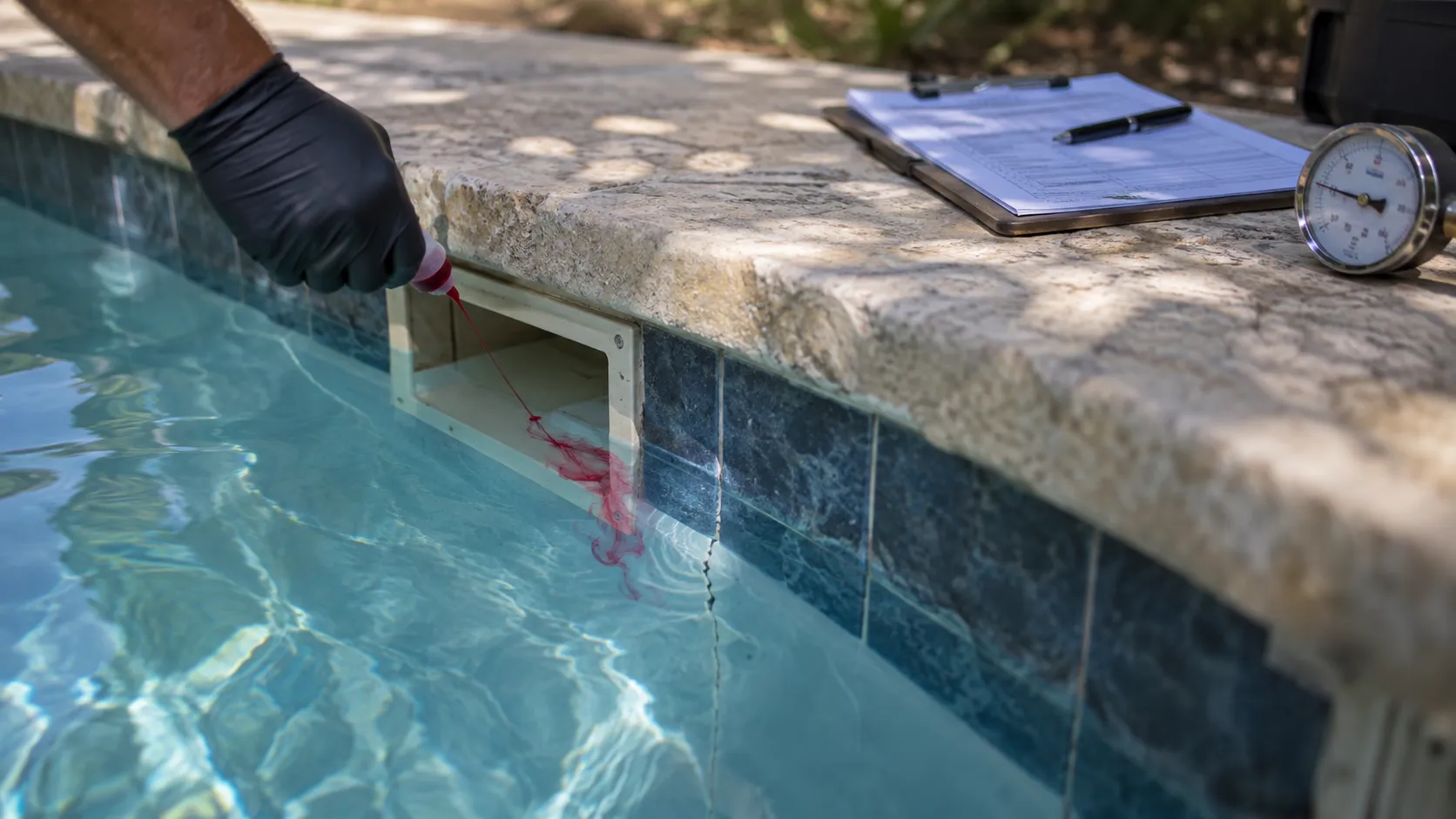
Once you know there is a leak, the dye test is a hands-on way to locate leaks in areas of the pool you can physically access. It is one of the oldest and most effective methods for narrowing down the leak location, and you can do it yourself with a bottle of leak detection dye or even dark food coloring.
The concept is simple. You release a small amount of dye near a suspected crack, fitting, or joint. If there is a leak at that spot, the water current created by the escaping water will pull the dye toward the opening. If there is no leak, the dye will simply drift and dissipate.
Where to perform a dye test:
- Around the skimmer. This is one of the most common pool leak locations. Squeeze dye along the joint where the skimmer meets the pool wall, around the faceplate, and near the skimmer throat. Watch closely — if the dye gets pulled into a gap or crack, you have found an active leak near the skimmer.
- Return fittings. Hold the dye right at the edge of the pool wall where each return fitting sits. A cracked gasket or loose fitting will draw the dye inward.
- Pool light niche. The conduit behind the pool light is a notorious leak point. Release dye around the light ring and the conduit opening and watch for any pull.
- Along the waterline and tile line. Move slowly along the edge of the pool and release small puffs of dye at any visible crack, chip, or gap in the tile or plaster. Structural cracks along the waterline are common in older inground pools.
- Spa spillway and water features. Any transition point between structures — where the spa meets the main pool, or where a waterfall connects — is a potential leak point. Dye test every visible joint.
- Vinyl liner seams (if applicable). For vinyl liner pools, focus on seams, corners, and areas around the main drain, skimmer, and return fittings. Wrinkles or soft spots in the vinyl often indicate water escaping behind the liner. A vinyl patch kit with epoxy or putty can fix minor tears, but larger damage may mean the pool liner may need to be replaced.
Critical: Turn off the pool pump before testing. The pool water must be completely still. Even minor circulation will scatter the dye and make it impossible to read the results.
A successful dye test can pinpoint the exact location of a shell or fitting leak quickly and cheaply. But if you dye test every accessible area and still cannot find the source, the leak is likely in the underground plumbing — and that is where professional leak detection comes in.
How Professional Leak Detection Locates Leaks in Underground Plumbing
Some leaks are easy to find with a dye test and a careful eye. But leaks in underground pipes, buried suction lines, return lines, main drain runs, and conduit connections are invisible from the pool surface. These underground leaks are also the most damaging because the water escaping goes directly into the soil, where it causes erosion, shifting, and potential foundation problems.
At Austin Pool Leak Detection, we use Leaktronics-certified leak detection equipment specifically designed to locate leaks in underground plumbing with pinpoint accuracy. Here is how the process works:
Pressure testing is the foundation of professional leak detection. We isolate each plumbing line individually — the main drain, skimmer line, return lines, spa lines, and any dedicated water feature plumbing — and pressurize them with air or water to a calibrated level (typically around 1.5 times normal operating pressure). A line that cannot hold pressure has a leak. This tells us exactly which run has failed before we ever start searching for the leak location.
Acoustic listening devices allow our technicians to hear the sound of water or air escaping from underground pipes. These specialized instruments amplify the faint noise of a leak and help us pinpoint the exact location along the pipe run — often within inches. This is the technology that separates professional leak detection from guesswork.
Pipe camera inspection gives us a visual inside the plumbing lines when accessible. A small waterproof camera fed through the pipe reveals cracks, joint separations, root intrusion, and other damage. This is especially valuable for older pools where the pool plumbing has been stressed by decades of soil movement.
Electronic leak detection can also be used on pool shells, vinyl liners, and spa surfaces to detect electrical conductivity changes at the leak point. This method is particularly effective for locating pinhole leaks in vinyl that a standard dye test might miss.
The result is a precise diagnosis — not just confirmation that a leak exists, but the exact location, the affected component, and a clear set of repair options. That precision is what saves you money, because it means the repair targets only the failed section rather than requiring exploratory digging or unnecessary replacement.
Where Pool Leaks Cost You the Most Money
Not every pool leak costs the same to ignore. Understanding where the biggest financial risks are helps you prioritize what to address first and why locating pool leaks quickly pays off.
The pattern is clear: the longer a leak runs, the more expensive the consequences become. A $300 pool leak repair today can prevent a $3,000 plumbing excavation or a $10,000 foundation stabilization next year.
Check the Equipment: Leaks You Can Spot Yourself
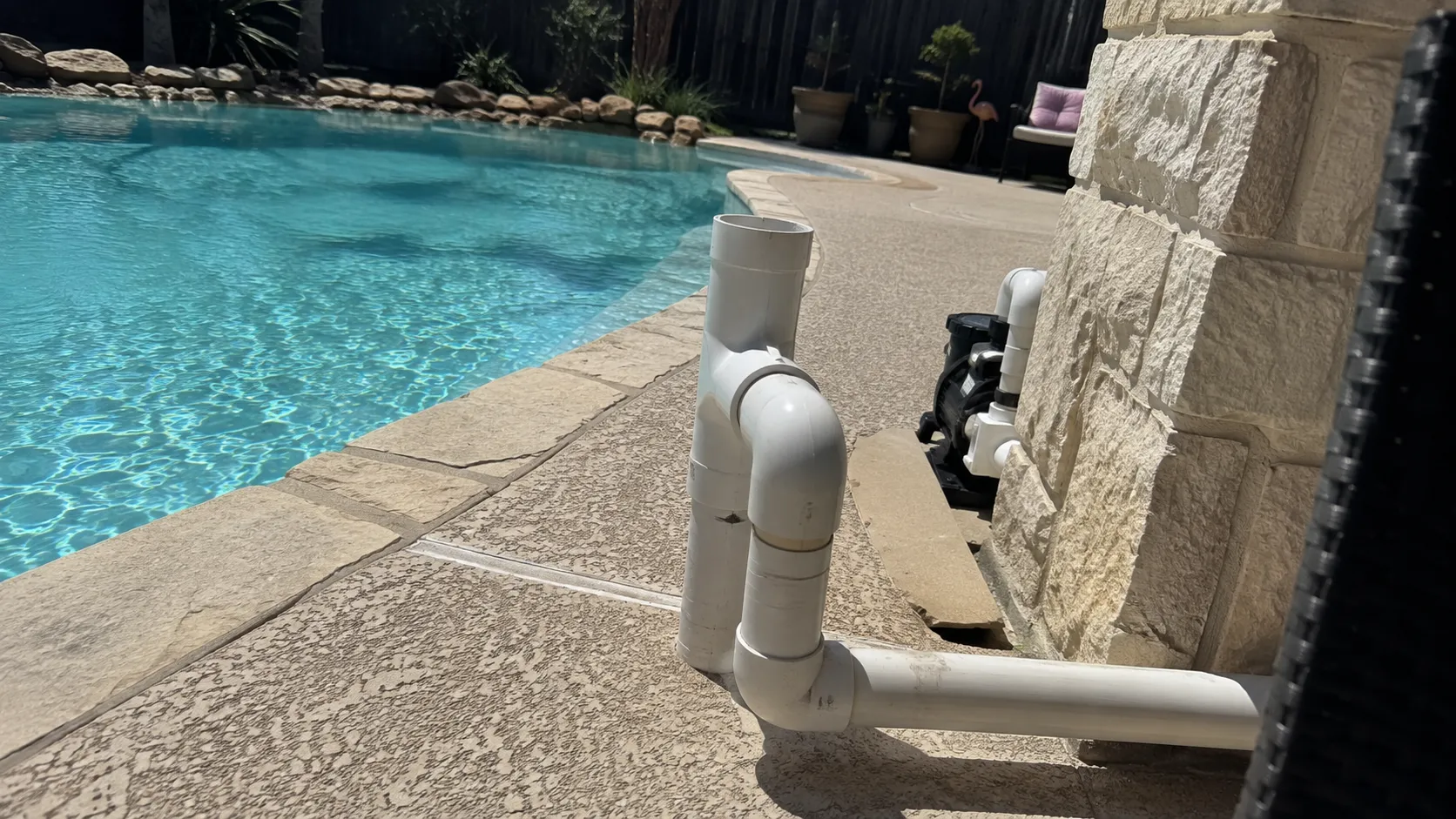
Before calling for professional leak detection, take a few minutes to check the equipment yourself. A leak at the equipment pad is often the easiest to spot and the cheapest to fix — and it might explain the water level drop you have been noticing.
Walk the equipment pad and look for:
- Drips around the pump shaft seal. A small, steady drip from the pump housing is a classic sign the shaft seal is worn. This is one of the most common equipment leaks and a straightforward repair.
- Moisture or mineral buildup around pipe unions and valves. White calcium deposits or green corrosion at threaded connections mean water has been seeping. Tightening a union or replacing a worn O-ring or gasket can often fix the issue.
- Water pooling beneath the filter. A cracked filter housing, worn drain plug, or failing belly band gasket can leak water directly onto the ground. If the filter is old and the housing is cracked, it may need to be replaced.
- Backwash valve dripping when the system is running. A multiport or push-pull backwash valve that does not seat properly will leak water into the backwash line continuously. You may not see this because the water exits through the waste pipe, but it still drains your pool. A worn spider gasket inside the valve is usually the culprit — inexpensive putty or gasket replacement fixes it.
- Wet ground around the heater or salt cell. Check for drips at the header connections, heat exchanger, and any unions. Corrosion is common on heater components, and a small drip can become a steady flow if the fitting corrodes through.
If the equipment is running fine and everything looks dry, but the pool is still losing water, the leak is somewhere else — in the shell, the plumbing lines, or the fittings inside the pool. That is when you suspect a leak in a harder-to-reach area and it is time to call a specialist.
How Much Money Does Locating a Pool Leak Actually Save?
Let us put real numbers behind why locating pool leaks early matters for your wallet.
Water costs. A pool leak losing one inch of water daily from a standard 15x30-foot inground pool wastes roughly 460 gallons per day — that is over 14,000 gallons per month, or about 168,000 gallons per year. At Austin Water's tiered rates, that kind of excess usage can add $100 to $300+ per month to your water bills, depending on your tier. Over a single swimming season, that is $500 to $1,500 in wasted water alone.
Chemical costs. Every gallon of leaked water takes dissolved chemicals with it. Replacing the chlorine, stabilizer, acid, and other chemicals that escape with the leak adds another $30 to $80 per month in unnecessary spending.
Equipment replacement. A pump running with low water regularly overheats and wears out the seal, bearings, and motor faster. Replacing a pool pump costs $400 to $1,200 depending on the model. A pool that runs properly with a consistent water level can extend pump life by years.
Structural and soil damage. This is where the real savings come in. Water escaping from underground pipes erodes the soil beneath your pool deck, around your foundation, and through your landscaping. In Austin's expansive clay, that moisture creates swelling and shifting that leads to cracked decks, settling structures, and in the worst cases, foundation damage costing $5,000 to $25,000+ to repair.
Compare that to the cost of professional leak detection. A thorough pool leak detection appointment typically costs a fraction of even one month's wasted water. When you factor in the avoided damage, the return on investment is overwhelming. Locating pool leaks is not an expense — it is a savings strategy.
Why Austin Pool Owners Trust Us to Locate Leaks
Austin Pool Leak Detection was founded because our team saw too many pool owners paying for guesswork. General pool service companies can clean your pool and balance your chemicals, but when there is a leak somewhere in the system, you need a specialist with the right leak detection equipment and training to find it.
Our Leaktronics-certified technicians focus exclusively on pool and spa leak detection. We do not sell pool cleaning packages or equipment upgrades. We find leaks — that is what we do every single day. That focus means we have the experience to detect a leak quickly, the equipment to pinpoint the exact location, and the knowledge to recommend repair options that fix the issue without unnecessary cost.
We serve pool owners throughout Austin, Lakeway, Buda, San Marcos, New Braunfels, and Canyon Lake. Whether you suspect a leak in your inground pool, your spa, or your pool plumbing, we will locate it, document it, and give you a clear path to repair.
Do not let a pool leak drain your wallet. Call Austin Pool Leak Detection today at 737-394-5325 to schedule your appointment. We will find the leak, give you honest answers, and help you fix the issue before it gets worse.
.png)