.png)
Detecting Pool Leaks Before They Worsen: A Guide for Austin Pool Owners
Learn how to detect a swimming pool leak early using the bucket test, dye test, and pressure test.
.webp)
A pool leak does not announce itself. There is no alarm, no flashing light, and no obvious puddle on the deck. Most swimming pool leaks start small, a hairline crack in a fitting, a slight separation around the skimmer, or a pinhole in an underground plumbing line. Left alone, that minor leak quietly drains water, drives up your water bills, erodes the soil around the pool, and turns into a repair bill that could have been a fraction of the cost if caught early.
At Austin Pool Leak Detection, we help pool owners across Austin, Lakeway, Buda, San Marcos, New Braunfels, and Canyon Lake detect and repair leaks before they become serious problems. Our Leaktronics-certified technicians use professional leak detection equipment to locate leaks with precision — no guesswork, no unnecessary digging.
This guide walks you through how to spot the early warning signs, how to test for a leak at home, and when it is time to call in a professional for pool leak detection services.
How to Tell If Your Pool Is Leaking or Just Losing Water Due to Evaporation
Every pool loses some water. In Austin's intense heat, evaporation can account for a quarter inch of water daily during peak summer. But when your pool is losing water faster than that — say an inch of water daily or more — something else is going on. The trick is knowing the difference between normal water loss and a swimming pool leak that needs attention.
Here are the early warning signs that there's a leak rather than simple evaporation:
- Your pool's water level drops more than a quarter inch per day. If you are topping off the pool every couple of days and still watching the waterline fall, the water loss is likely beyond what evaporation can explain.
- Your water bills have spiked without a change in usage. A pool leak can waste thousands of gallons per month. That shows up on your bill before you notice it at the pool.
- You see wet or soggy spots in the yard around the pool. Water escaping from underground plumbing has to go somewhere. If you notice areas around the pool that stay damp when they should be dry, a leak may be pushing water into the surrounding soil.
- The pool pump runs more often or struggles to maintain prime. When water level drops near the skimmer, the pump pulls air instead of water. If your pool equipment cycles on and off or you hear gurgling at the skimmer, the pool water level may be dropping faster than you realize.
- You are adding more chemicals than usual but cannot maintain balance. Fresh water dilutes your pool water chemistry. If you are constantly adjusting chlorine and pH, a leak may be flushing treated water out and replacing it with untreated fill water.
Any one of these signs is worth investigating. Two or more together strongly suggest your pool is leaking and needs a closer look.
The Bucket Test: A Simple Way to Compare the Water Level
Before you call anyone, you can perform a quick test at home to confirm whether the drops in water are from evaporation or a leak. The bucket test is the most widely recommended first step, and it takes less than five minutes to set up.
Here is how it works:
- Fill a five-gallon bucket with pool water and place it on the first or second step of the pool so it is partially submerged.
- Mark the water level inside the bucket and mark the pool's water level on the outside of the bucket. You want the water to match at both marks when you start.
- Turn off the pool pump, autofill, and any water features. You need still, undisturbed conditions for an accurate reading.
- Wait 24 hours.
- Compare the water level in the bucket to the pool water level. If the pool's water level dropped noticeably more than the level in the bucket, your pool is losing water beyond normal evaporation — and you likely have a leak.
Pro tip: If the result is borderline, repeat the test over 48 hours for a clearer reading. Wind, rain, and heavy pool usage can skew a single-day result. Running the test on a calm day gives you the most reliable comparison.
If the bucket test confirms excess water loss, do not wait to investigate further. A minor leak today can become a major plumbing or structural repair within weeks, especially in Austin's expansive clay soil where water escaping underground causes rapid soil shifts.
The Dye Test: How to Pinpoint the Leak Yourself
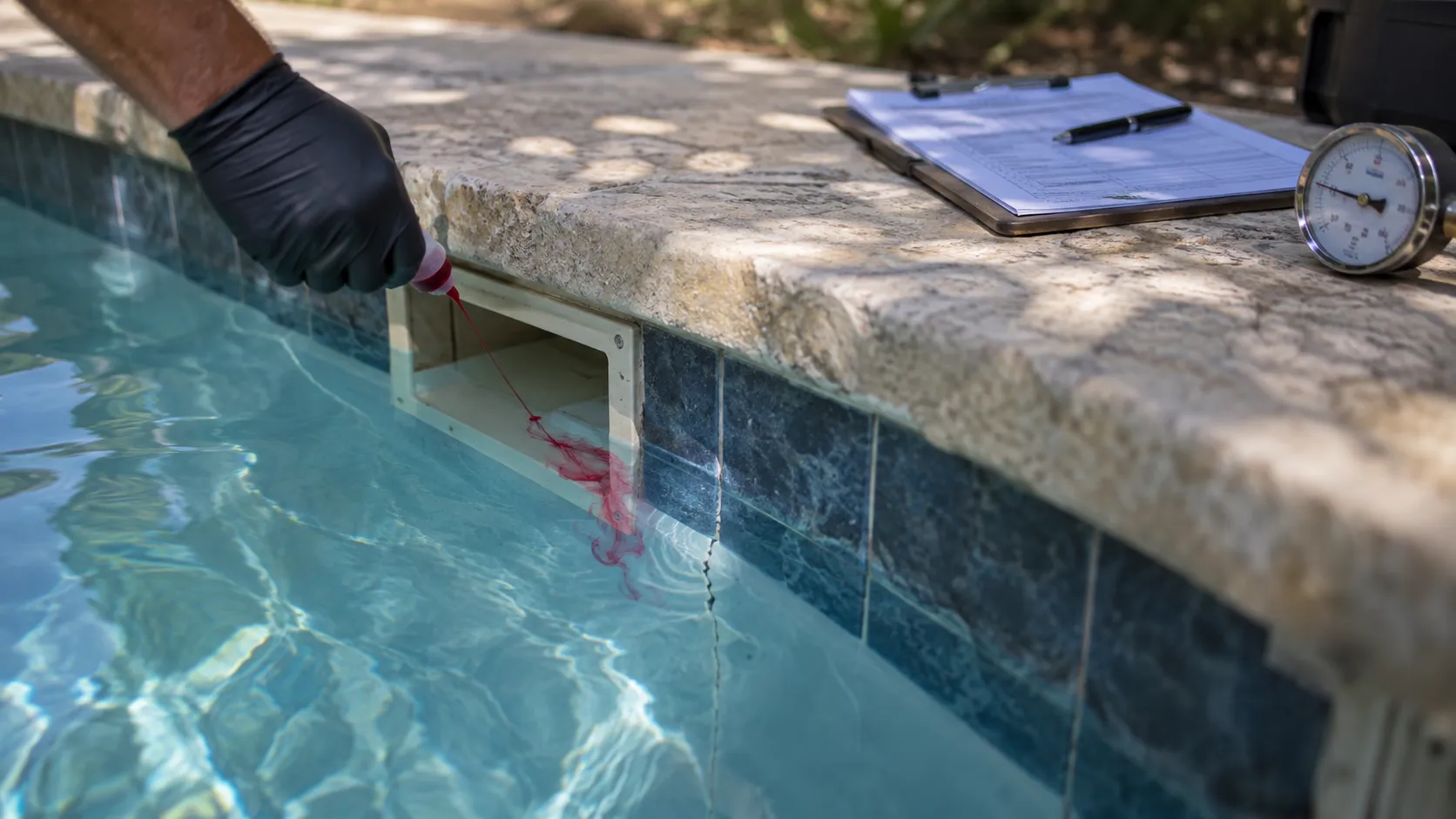
If the bucket test confirms you are losing much water beyond evaporation, the next step is trying to narrow down the location of the leak. A dye test is a simple, hands-on method that helps you see the dye get pulled toward the exact spot where water is escaping.
You can pick up leak detection dye at most pool supply stores, or you can use dark food coloring in a pinch. The idea is to release a small amount of special dye near a suspected leak point and watch closely. If there's a leak at that spot, the dye will be drawn toward the crack or gap instead of drifting with the normal water current.
Best areas around the pool to dye test:
- Around the skimmer — Skimmer leaks are one of the most common types. Release dye near the skimmer faceplate, throat, and the joint where the skimmer meets the pool wall. If the dye pulls into any seam or crack, you have found an active leak near the skimmer.
- Return fittings — Check each return jet by holding the dye close to the fitting where it meets the pool wall. A loose or cracked fitting will pull the dye inward.
- Pool light niche — The conduit behind the pool light is a frequent leak source. Release dye around the light ring and watch for movement into gaps.
- Tile line and waterline — Cracks along the tile line or at the waterline are common in inground pools, especially older ones with settling or shifting soil. Move slowly along the wall and release small amounts of dye at any visible crack.
- Steps, benches, and spa spillway — Any area where the pool shell transitions or where separate structures join is a potential leak point.
Important: Turn off the pool pump before performing a dye test. You need the pool water completely still. Even slight circulation will scatter the dye and make it impossible to see the dye being drawn to a specific spot.
The dye test works well for leaks in the pool shell, fittings, and visible plumbing connections. However, it cannot detect a leak in underground plumbing, buried pipes, or areas you cannot physically reach. If you perform a dye test around the pool and do not find the source of the leak, the problem is likely underground or in the plumbing lines — and that requires professional leak detection equipment.
Pressure Testing: How Professionals Locate Leaks in Plumbing
When a dye test does not reveal the location of the leak, or when the leak happens in buried plumbing, a pressure test is the next step. This is where professional pool leak detection makes the difference between guessing and knowing exactly where the problem is.
A pressure test works by isolating each plumbing line — the main drain, skimmer line, return lines, spa lines, and any water features — and pressurizing them individually with air or water. If a line cannot hold pressure, it has a leak. This method allows our technicians to determine not just that a leak exists, but which specific pipe or run has failed.
At Austin Pool Leak Detection, we use Leaktronics-certified leak detection equipment that goes beyond basic pressure testing. Once we identify a failing line, we use acoustic listening devices to detect the sound of water or air escaping underground. This lets us pinpoint the leak to a specific section of pipe without digging up the entire yard. In many cases, we can locate leaks within inches of their exact location, which means the repair is targeted and minimally invasive.
We also use pipe camera inspection when accessible. A small camera fed through the plumbing gives us a visual of the pipe interior, revealing cracks, root intrusion, joint separation, and other damage that pressure testing alone cannot characterize. This is especially useful for older pools and spas in Austin where the plumbing has been stressed by decades of soil movement and temperature cycling.
Common Pool Leak Locations Every Pool Owner Should Know
Not all leaks are created equal, and knowing where leaks most commonly occur can help you catch problems earlier. Here are the areas around the pool and its plumbing where leaks happen most frequently:
Understanding these common leak locations helps you perform a more targeted dye test at home and gives you useful information to share with a leak detection professional when you call.
Why You Should Never Ignore a Minor Leak
It is tempting to brush off a small, slow leak as a minor inconvenience. Maybe you just top off the pool once a week and move on. But even a simple leak that seems manageable today can escalate quickly, and the costs add up in ways most pool owners do not realize until the damage is done.
Water waste and rising bills. A pool leak losing just one inch of water daily can waste over 7,000 gallons per month. In Austin, where water rates continue to climb, that translates to hundreds of dollars in extra water bills every season.
Soil erosion and structural risk. Water escaping underground does not just disappear. It saturates the surrounding soil, and in Austin's expansive clay, that creates swelling, shifting, and erosion that can damage your pool deck, landscaping, and even your home's slab foundation. A minor leak left alone for a few months can create thousands of dollars in soil and structural damage.
Equipment strain. When the pool water level drops, the pool pump works harder to maintain suction. Running the pump with low water stresses the motor, overheats the seal, and shortens the life of your pool's filter system and other pool equipment. Fixing a leak is always cheaper than replacing a burned-out pool pump.
Chemical imbalance. Constantly adding fresh water dilutes the pool water chemistry. You end up spending more on chemicals, struggling to maintain balance, and increasing the risk of algae growth — all because the leak is flushing treated water out faster than you can replace it.
The repair gets bigger. A leak that starts as a small crack in a fitting can grow into a full pipe separation. A minor skimmer leak can erode the surrounding concrete and turn into a pool renovation project. Detecting pool leaks early and consulting a professional before they worsen is always the most cost-effective path forward.
When to Call a Professional for Pool Leak Detection
Some leaks are straightforward enough to find with a bucket test and a dye test. But most swimming pool leaks, especially those in underground plumbing or hard-to-reach areas, require professional leak detection to locate accurately. Here is when it is time to stop troubleshooting on your own and bring in a specialist:
- The bucket test confirms water loss, but you cannot find the source of the leak with a dye test.
- The pool is losing water whether the pump is on or off, which suggests the leak is in the shell rather than the plumbing.
- You notice wet areas in the yard but cannot determine where the water is coming from.
- Equipment leaks have been ruled out, but the pool's water level keeps dropping.
- You want to detect and repair leaks before selling your home or during a real estate transaction.
At Austin Pool Leak Detection, our professional leak detection process covers every possibility. We start with a thorough visual inspection, move to pressure testing and acoustic detection, and use dye tests and pipe cameras to pinpoint the leak with precision. We provide a detailed report with photos and repair options so you understand exactly what needs to be fixed and what it will cost.
Our leak detection services cover pools and spas across Austin, Buda, Lakeway, San Marcos, New Braunfels, and Canyon Lake. Whether you have an inground pool with a concrete shell, a vinyl liner pool, or a spa with water features, we have the equipment and experience to find and fix the problem.
Keep Your Pool in Great Shape — Detect Leaks Early
Detecting pool leaks before they worsen saves you money, protects your property, and keeps your pool running the way it should. Do not wait for a minor leak to turn into a major repair. The earlier you catch it, the simpler and less expensive the fix.
If your pool is losing water, your water bills are climbing, or you have noticed any of the warning signs described in this guide, take action now. A quick bucket test at home can confirm your suspicion, and a professional leak detection appointment can pinpoint the exact location and give you a clear path to repair the leak.
Call Austin Pool Leak Detection today at 737-394-5325 to schedule your leak detection appointment. Fast, accurate, and guaranteed — we find every leak so you can get back to enjoying crystal-clear water and a worry-free pool.
.png)