.png)
Austin Leak Detection: Why Pool Leaks and Plumbing Leaks Need Two Different Experts
austin leak detection
Search "Austin leak detection" and you get two kinds of companies mixed together. Some find slab leaks, water line breaks, and leaks behind floors or walls. Some find swimming pool leaks. A few claim to do both.
We only do pools. We do not apologize for that. It is the reason we find leaks that general leak detection companies miss. A pool is its own plumbing system. It has its own weak points and its own tools for finding them.
This guide explains the two trades. It shows you how to tell which kind of leak you have. Then it walks through what real swimming pool leak detection in Austin looks like when a pool expert does it.
Austin Leak Detection Is Really Two Different Trades
A general leak detection service works on the water lines that feed your house. Think slab leaks under the home, a hot water line to the water heater, a drain line, a faucet, or a valve in the yard. Their tools are built for copper and PEX under a concrete slab.
Pool leak detection is a different job. A pool loses water through the shell, the skimmer, the pool light niche, the returns, the main drain, and the buried PVC that ties it all together. Most of that plumbing runs under suction or low pressure, not house pressure. The methods that find a slab leak do not carry over.
Nine times out of ten, when a general leak detection company gets called to a pool, they pressure test the equipment and call it a day. That is one step of a six-step process. The leak is still there. The homeowner just paid to learn what they already knew.
The best Austin leak detection results come from calling the right expert for the right system. Here is how to know which one you need.
Pool Leak or Plumbing Leak? How to Tell
Many Austin homeowners with a pool assume every high water bill is a pool problem. Sometimes it is. Sometimes the pool is fine and the house is losing water. A few checks sort it out before you call anyone.
The quickest test is the water meter box. Turn off every fixture and the pool auto-fill. If the meter still moves, the house is losing water. Call a plumber. If the meter holds but the pool keeps dropping, the leak is in the pool.
We covered the plumber question in more depth in our guide on pool leak detection vs. a plumber.
Signs You May Have a Pool Leak
Pool leaks in Austin rarely announce themselves. Most show up as small changes that add up over a season. Watch for these:
- Losing more than a quarter inch of water every day beyond normal summer loss.
- Auto-fill running far more often than it used to.
- High water bills with no change in how you use water.
- Air bubbles at the return jets, or a pump that struggles to prime.
- Wet or soft spots around the pool that never dry.
- Cracks in the pool deck, tile line, or plaster.
- Algae showing up faster because the chemistry will not hold.
- Settling or shifting around the pump pad.
One of these alone can have another cause. Two or three together almost always indicate a leak. Even the smallest leaks waste thousands of gallons a month. An undetected leak can also shift the soil under the pool. Early detection is the difference between a small fix and a big one.
If you see these signs anywhere in the Austin area, book a leak detection visit before the summer heat makes it worse.
Swimming Pool Leak Detection in Austin: What We Actually Do
Real swimming pool leak detection is a process, not a single test. Here is how our leak detection team runs a standard residential pool job.
1. Water loss check. A bucket test separates a true leak from Austin's brutal summer water loss. It sounds simple. It saves a lot of people a service call.
2. Pressure test every line. Each pipe gets tested on its own: skimmer line, main drain, returns, cleaner line, and the pool light conduit. This tells us which line is losing water and roughly how much.
3. Listen for the leak. We use sonar to find air escaping through a crack into wet soil. Leaktronics listening gear lets us trace that sound through the pool deck to the exact leak location.
4. Camera inspections to locate leaks inside the pipe. For unclear cases, a pipe camera goes into the line. It shows us the crack or the bad joint.
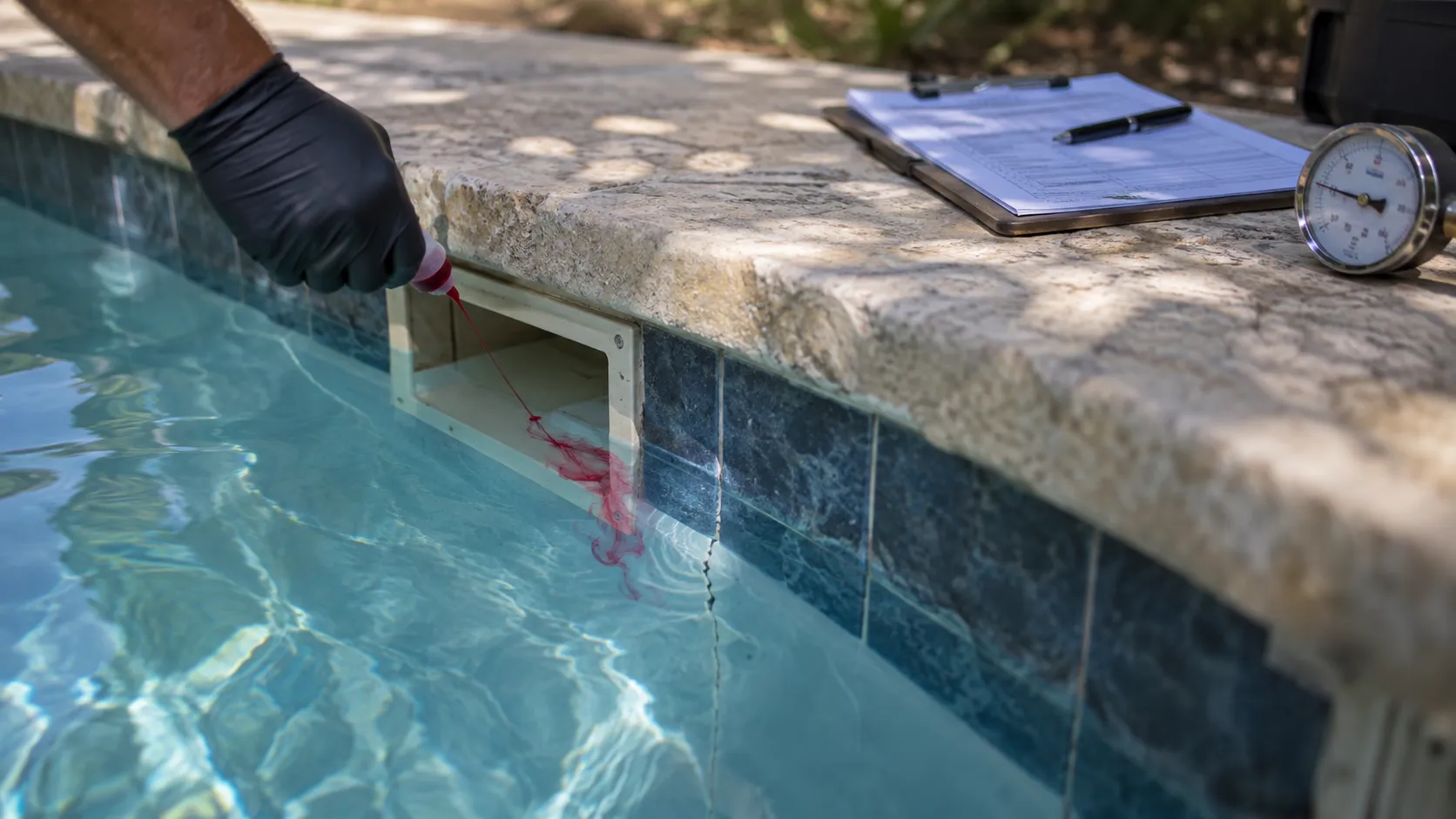
5. Dye test the shell. Skimmer throats, light niches, returns, and any visible cracks get dye tested under water. This finds the leak source in the pool itself.
6. Report and plan. You get photos, the exact leak location marked on the deck, and a plain-English plan for what to fix first.
Every step is non-invasive. No concrete gets cut to find the leak. We back the whole process with a find it or keep looking guarantee. If we cannot locate the leak on the first visit, we keep coming back until we do.
Full details are on our pool leak detection service page.
Why a Pool Expert Beats a General Leak Detection Company
This is the honest case for calling a pool expert. It comes down to three things.
Tools. Advanced leak detection for pools means gear built for pool plumbing. That means listening tools tuned for PVC under suction, dye testing, underwater checks, and pipe cameras sized for pool lines. General leak detection equipment is built for house water lines under pressure.
Pattern recognition. A technician who works on pools every day knows the patterns. A pump losing prime usually means a suction leak. A light niche is a common leak source. A hairline crack at the skimmer throat is the first place to check after a freeze. That instinct only comes from doing pool detection work over and over.
Repair path. Once we find the leak, we can fix the leak or line up the repair. That includes non-invasive pool pipe leak repair that seals buried lines from the inside. A general leak detection company hands you a report and leaves you to find a pool company.
We are not a plumber and we never pretend to be. If your leak is in the house, we will tell you that and point you to the right trade. If it is in the pool, you are already talking to the right people.
What We Do Not Do (and Who to Call Instead)
Being clear about scope is part of doing Austin leak detection right. We do not handle:
- Slab leaks under the home.
- Water line breaks between the meter and the house.
- Faucet, toilet, or water heater leaks.
- Drain line or sewer leaks.
- Commercial leak detection for building plumbing.
For any of those, a licensed plumber or a general leak detection service is the right call. For a residential pool, spa, or fountain, it is us.
Austin Leak Detection Service Area for Pools
We provide swimming pool leak detection and repair throughout the Austin metro area, including:
- Austin.
- Round Rock, Cedar Park, Pflugerville, and Leander.
- Lakeway and West Lake Hills.
- Buda and the southern suburbs.
- San Marcos, New Braunfels, and Canyon Lake.
Round Rock properties and the northern suburbs are on our regular route. Same-day scheduling is open across most of our roughly 20-mile radius.
Buying a home with a pool anywhere in Central Texas? Our pool inspection includes leak screening as part of the standard visit.
Book Pool Leak Detection in Austin
If your pool is losing water, do not guess at the leak location. Do not pay a generalist to run one test. Call the Austin leak detection team that only does pools.
Call 737-394-5325 or request a quote online. We find the leak, show you exactly where it is, and give you a clear plan to fix it.
.png)