.png)
How Much Does Pool Leak Detection Cost? What Actually Moves the Price in Austin
How much does pool leak detection cost in Austin? What moves the price, why free detection can cost more, and how it fits with pool leak repair costs.
Your water level keeps dropping. The auto-fill never seems to stop. So you searched pool leak detection cost and found three kinds of answers: national cost guides with wide ranges, forum threads where everyone paid something different, and a few Austin companies offering leak detection for free.
That spread confuses pool owners, and it should. The price on the quote is only part of the cost. The real cost is whether the visit finds every leak the first time.
We run pool leak detection across Austin every week. Here is what moves the price, why "free" is not always free, and how detection fits into the full repair bill. We will not throw out a number, because a number without seeing your pool is a guess.
Why National Cost Guides Only Tell Half the Story
Angi and HomeGuide both publish national cost data for leak detection and repair. It is a fair starting point. But those averages blend quick spa checks with complex inground pool jobs. They also blend low-cost markets with cities like Austin.
A national cost average cannot see your pool. It does not know if you have an attached spa, how long your plumbing runs are, or if a freeze cracked three lines last winter. Your local pool sets the price, not the national average. That holds whether you call a national franchise like American Leak Detection or a local specialist.
The cost guides agree on one thing, though. The price of finding a leak is usually far smaller than the price of fixing the damage a leak causes when nobody finds it.
What Drives Pool Leak Detection Cost
Six things move the price of a pool leak detection service. None of them are about the company. They are about the pool.
- Pool type and size. The type of pool matters. A concrete or gunite inground pool has more places to check than a small vinyl pool or an above-ground pool. Bigger pools take longer to test.
- An attached spa. A spa adds its own lines, jets, and fittings. That can nearly double the plumbing we test.
- How many lines the pool has. Skimmer lines, main drain, returns, cleaner line, and the pool light conduit each get tested on their own. Complex plumbing takes more time.
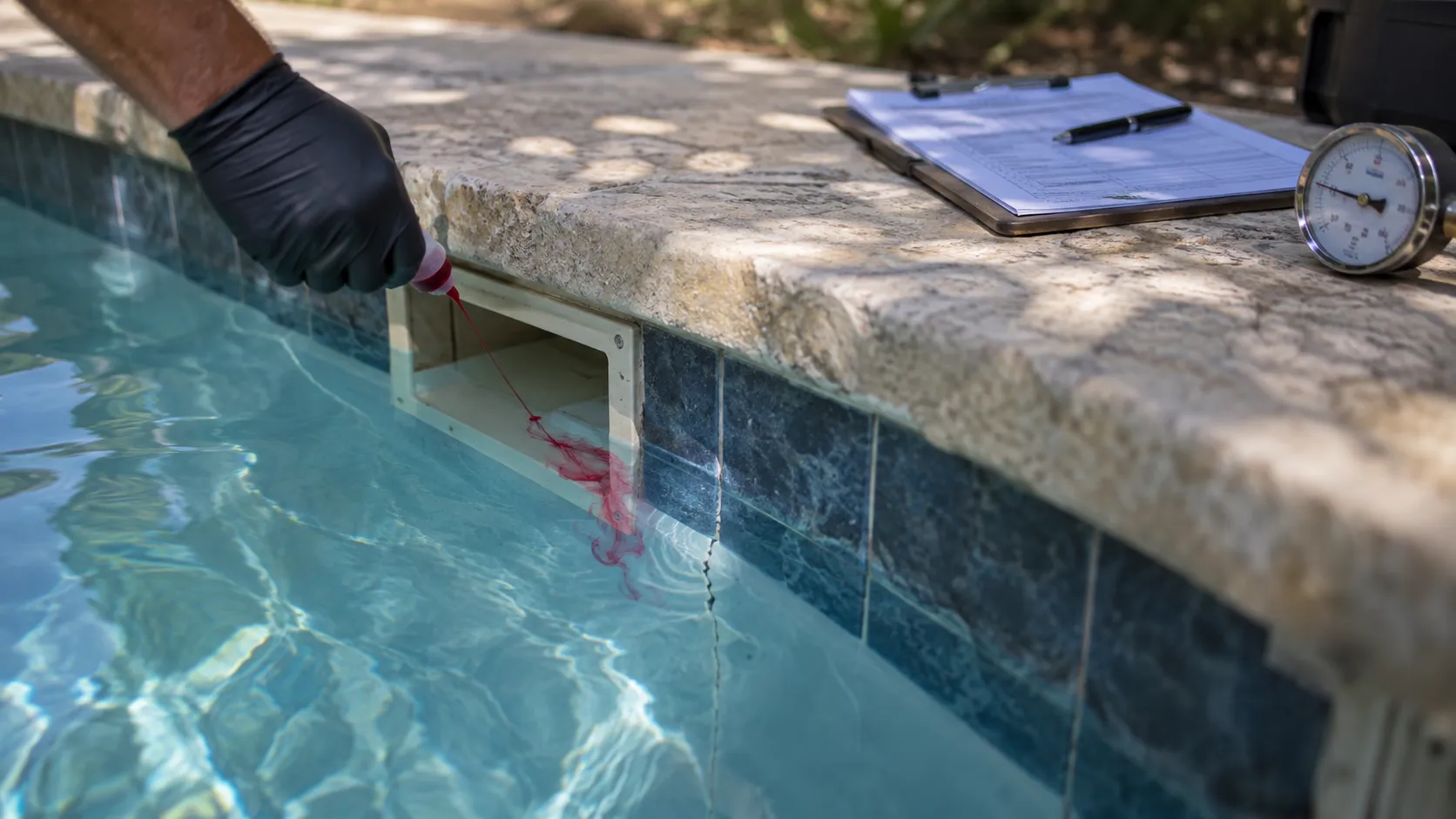
- Where the leak is. A leak in the pool shell is often found with a dye test. A leak in underground plumbing takes pressure testing and sonar to pin down.
- How many leaks there are. After a hard freeze, many Austin pools have more than one. Finding the second and third leak takes extra time.
- Access. Clear valves and a tidy equipment pad make testing faster. Unmarked valves and heavy hardscape slow it down.
Here is how those factors stack up on a relative scale.
The pattern is simple. The more plumbing a pool has, and the deeper the leak hides, the more time it takes to find.
Free vs. Paid Pool Leak Detection: Where the Cost Actually Goes
Search around Austin and you will see companies that advertise free leak detection. That sounds like an easy choice. It deserves a closer look.
Real leak detection takes a trained tech, specialized gear, and real time on site. That work has a cost. When the visit is free, the cost lives somewhere else, and that place is usually the repair.
Nobody runs sonar, pressure tests every line, and dye tests a whole pool for free. When detection costs nothing, the price is built into the repair. That can be fine with a company you trust. Just know the incentive: a free visit only pays off for them if it ends in a repair sale.
Free or paid, ask these questions before anyone shows up:
- Will you pressure test every line, or just the one you suspect?
- Will you dye test the pool surface, skimmer, light, and return fittings?
- What happens if you do not find the leak on the first visit?
- Do I get a written report with photos and the exact leak location?
- Can I take that report to another pool company for the repair?
Good answers matter more than a low price. A cheap or free visit that misses a second leak costs you a second visit, a second repair, and another month of water loss.
Our approach is simple. We find it or keep looking, and the report is yours to keep. Request a quote and you will know the cost before we start.
Is It a Leak or Just Evaporation? Check Before You Pay Anyone
Austin summers pull a lot of water out of a pool. Heat, sun, and wind can drop the water level fast. Before you pay for professional pool leak detection, rule out evaporation with a free bucket test.
- Fill a bucket with pool water and set it on the pool step.
- Mark the water level inside the bucket and on the pool wall.
- Turn off the auto-fill and wait 24 hours.
- Compare the two drops.
If the pool drops more than the bucket, you are losing water to a leak. Losing more than about a quarter inch of water per day beyond evaporation is a strong sign. Run the test once with the pump on and once with it off. The change in water flow points to where the leak lives, which can shorten the detection visit.
Where Inground Pool Leaks Usually Hide
Knowing the common spots helps you understand the quote. Most inground pool leak calls in Austin trace back to one of these:
- The pool skimmer. The throat where the skimmer meets the shell cracks as the deck shifts on our clay soil.
- The light niche. The conduit behind the pool light is a quiet, common leak point.
- Return jets and fittings. Seals and fittings wear out and let water slip behind the wall.
- The main drain. Harder to reach, so it takes more time to test.
- Underground plumbing. Buried lines crack from soil movement and freeze damage.
- A crack in your pool shell or tile line. Often visible up close, and easy to confirm with dye.
The leak location drives the detection time. It also drives the repair, which is the next question.
Pool Leak Detection Cost vs. Pool Leak Repair Costs
Detection and repair are two different bills. Detection finds the leak. Repair fixes it. Some companies find and repair, and some only find, so ask up front. The cost to fix a pool leak depends almost entirely on where the leak is and what sits on top of it.
- A leaking fitting at the pump is usually a small repair.
- A cracked skimmer throat is a medium job.
- A buried pipe can often be sealed from the inside with no digging. When it cannot, the deck work drives the repair bill.
- A crack in a concrete pool may be patched with hydraulic cement or epoxy, depending on the crack.
- Vinyl pools range from a simple vinyl pool liner patch to a full liner replacement.
DIY repair kits have their place. They work on a small leak you have already found. They do not help you find a leak in the first place.
Most leaks can be found and fixed without the need to drain your pool. Detection almost never requires it. A few repairs mean lowering the water level, which adds refill time.
For a deeper breakdown, see our guide on swimming pool leak repair cost. For buried lines, see how pool pipe leak repair works without digging.
What Waiting Costs You
The most expensive leak is the one nobody finds. A small leak left alone costs you in four ways at once.
- Your water bill climbs every month the pool keeps losing water.
- Refill water throws off your chemistry, so you spend more on chemicals.
- Escaping water softens the soil and can shift the deck and pool shell.
- A small leak grows. What starts as a cracked fitting can become a damaged pool structure.
Finding a pool leak early is the cheapest pool repair decision you will make. If your pool is leaking, book a leak detection visit before the damage spreads.
Does Homeowners Insurance Cover Pool Leaks?
It depends on your policy. Many policies treat sudden damage differently from slow leaks and wear. Some cover the damage a leak causes but not the leak detection itself.
Call your insurer before you assume either way. If you file a claim, a written report with photos and the exact leak location helps. Every leak detection we run includes that report. We are not insurance advisors, so your agent has the final word on coverage.
Getting a Real Number for Your Austin Pool
The honest answer to "how much does pool leak detection cost" is this: it depends on your pool, and a good company will tell you before they start.
When you call, have a few details ready. Tell us your pool type, whether you have a spa, what symptoms you see, and your bucket test result. That helps us give you a clear quote up front.
We serve Austin, Round Rock, Cedar Park, Pflugerville, Leander, Lakeway, West Lake Hills, Buda, San Marcos, New Braunfels, and Canyon Lake. Buying a home with a pool? Pool inspection costs are a separate line item, and our pool inspection covers leak screening too.
Book Pool Leak Detection in Austin
Stop guessing at the cost and the cause. Get a full check of every line, every fitting, and the pool shell, with a report you keep.
Call 737-394-5325 or request a quote online. We find the leak, show you where it is, and tell you what it will take to fix the leak.
.png)